
Bone Mineral Densitometry FAQs
-
Your healthcare practitioner may have referred you for a BMD scan for several reasons, including:
- Having a medical condition that may affect your bone strength
- You have had a fracture from minimal force/trauma
- You have been losing height
- You are at risk of osteoporosis
- Your healthcare practitioner wants to monitor changes in your bone density over time
- You wish to prevent osteoporosis even if you have no risk factors
A BMD scan is commonly used to help diagnose or rule out osteoporosis. Osteoporosis is a common condition where bones become weaker and more prone to breaking. It becomes more common as you age and is both preventable and highly manageable, with the goal of reducing the risk of fractures by strengthening existing bones and slowing bone loss.
-
- It’s helpful to wear clothes without metal from your chest to your knees. Common metal clothing items that interfere with results include bras with wires and clasps, navel piercings, press studs on jeans, and buckles and zippers. A gown can be provided on the day if you are unable to avoid any of these items.
- If you have internal metal, it is still okay to have a BMD scan, but please let the technician know, as we may scan a different location if it could interfere with the results.
- You will not need to fast and can take medication as usual. If you have recently had a scan that required contrast medium, please wait 3 days before doing a BMD scan.
- Please let us know if you are or may be pregnant, as the scan involves a very low level of radiation and shouldn’t be performed during pregnancy.
-
You will be required to lie on a bed during the scan. A trained technician will take images of your spine and hip. In some cases, your forearm may be scanned.
While only these areas are tested, the information collected reflects the bone strength of your entire skeleton.
You will also be asked a few questions about your medical history and lifestyle, which helps our doctors assess your overall fracture risk.
-
A BMD scan generally takes around 15 minutes. Before the scan, your weight, height and medical history are collected, so please allow 30 minutes for the entire appointment.
-
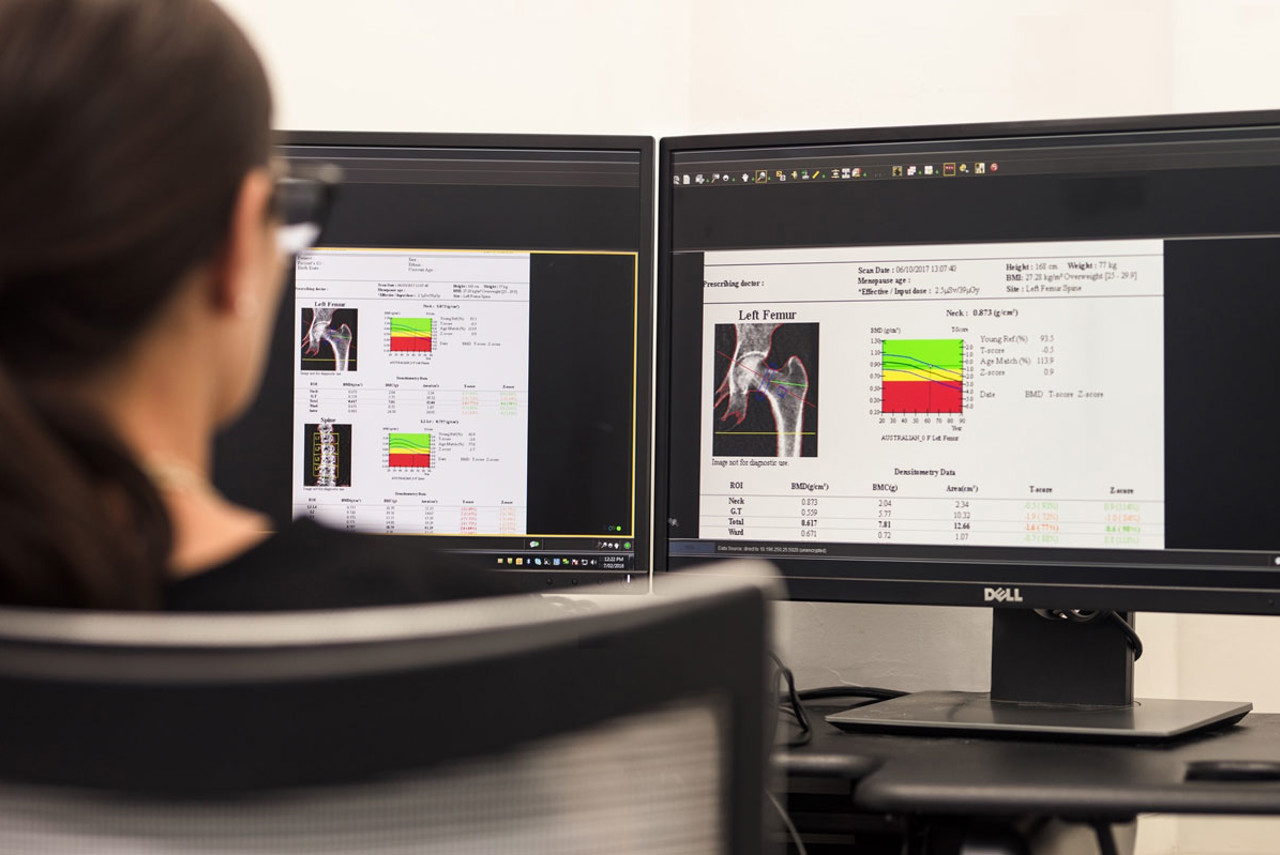
A radiologist will review your images and prepare a detailed report, which will be sent to your referring practitioner within 3 business days (and often within 24 hours). This report will include markers that indicate your bone health, including your FRAX score and T-score where relevant, an age-matched Z-score, and, in some cases, a trabecular bone score.
Your images will also be available in our Patient Portal.
You can return to your normal activities straight away after the scan.
-
A T-score compares your bone density to that of a healthy young adult of the same sex. It is the main measurement used to define osteoporosis.
A T-score is only relevant to patients who are post-menopausal or above the age of 50, and provides a WHO classification of osteoporosis, osteopenia or normal bones.
Other patients will receive only a Z-score, which is age-matched and is more relevant to younger populations to identify and track abnormal BMD.
Identifying bone loss early is important, as both osteopenia and osteoporosis can be managed with lifestyle changes and treatment to reduce your fracture risk.
-
A FRAX score an internationally recognised tool that helps estimate your risk of experiencing a fracture over the next 10 years. As part of your bone health assessment, our doctors will combine the information gathered from your scan, as well as information collected from a short medical history questionnaire, to determine your FRAX score where it is relevant.
Patients that are already on osteoporosis medication, have previously had a hip/vertebral fracture, pre-menopausal or under the age of 50, do not receive this on their report as these factors are outside of the scope of FRAX.
-
If you attend one of our Women's Imaging locations, your report will likely also include a Trabecular Bone Score (TBS), which provides additional detail about bone quality and structure.
-
Reports that include a T-score will diagnose osteoporosis based on WHO criteria. This score compares your bone mineral density to the peak bone density of a healthy young adult of the same sex. It is measured in standard deviations (SD) and is the primary indicator used to diagnose osteoporosis. It is important to establish bone density as early as possible, as a decrease can lead to bone fragility and other ailments.
Osteopenia is the term used when there is a small amount of bone loss, while osteoporosis is the term used when there is a larger amount of bone loss.
The T-score is generally not relevant in younger patients, and so a diagnostic classification of osteoporosis/osteopenia may be misleading. Instead, they are reported with a Z-score, which is sex and age-matched and helps to identify and monitor abnormal BMD.
-
To book a BMD scan online with Queensland X-Ray, access our portal here.
How much will it cost?
Fees for radiology procedures will vary depending on a variety of factors. We will advise you about the cost of your service at the time of booking but if you do have any questions, contact us and one of our team will be happy to help with your query. You can read more about our billing information here.
How do I access my images?
At Queensland X-Ray, we provide our patients with their images and results online. To access your images and results, you’ll need to register for an account when you visit one of our practices. If you’ve already registered, you can access the Patient Portal here.